Roughly a third of colourless diamonds emit light under ultraviolet. Where that light comes from, what the grading report is telling you, and why it is not a fault.
Take a diamond into a nightclub, or hold it under the ultraviolet lamp used to check banknotes, and it may begin to glow — usually a soft blue. Remove the lamp and the glow stops. That reaction is fluorescence, and around a third of colourless natural diamonds show it to some degree.
It appears on a grading report as a single word: None, Faint, Medium, Strong or Very Strong. It is probably the least understood line on the page, and the one most likely to make a buyer walk away from a stone they would otherwise have liked.
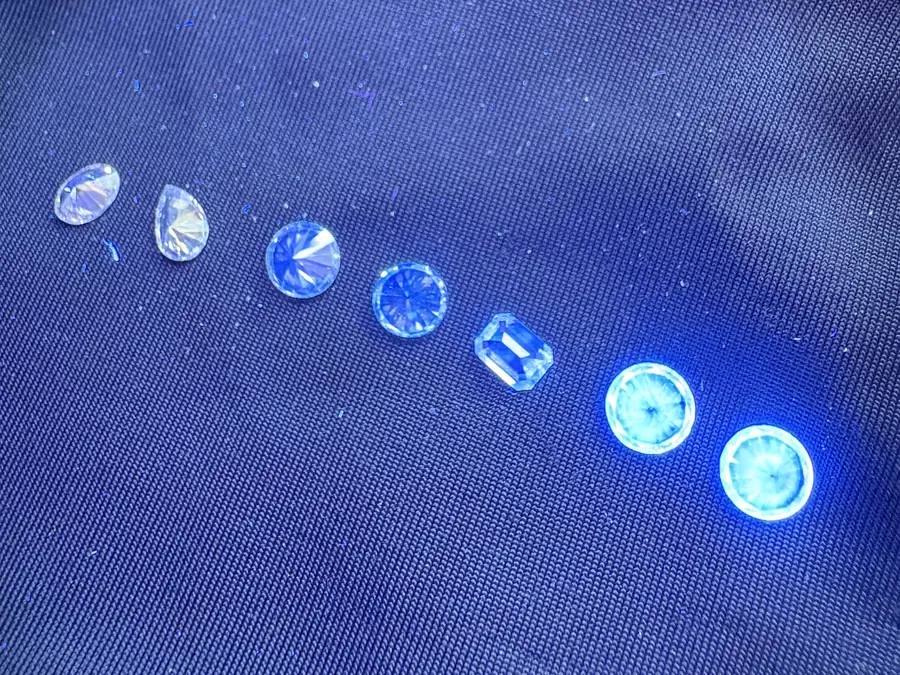
Under ultraviolet
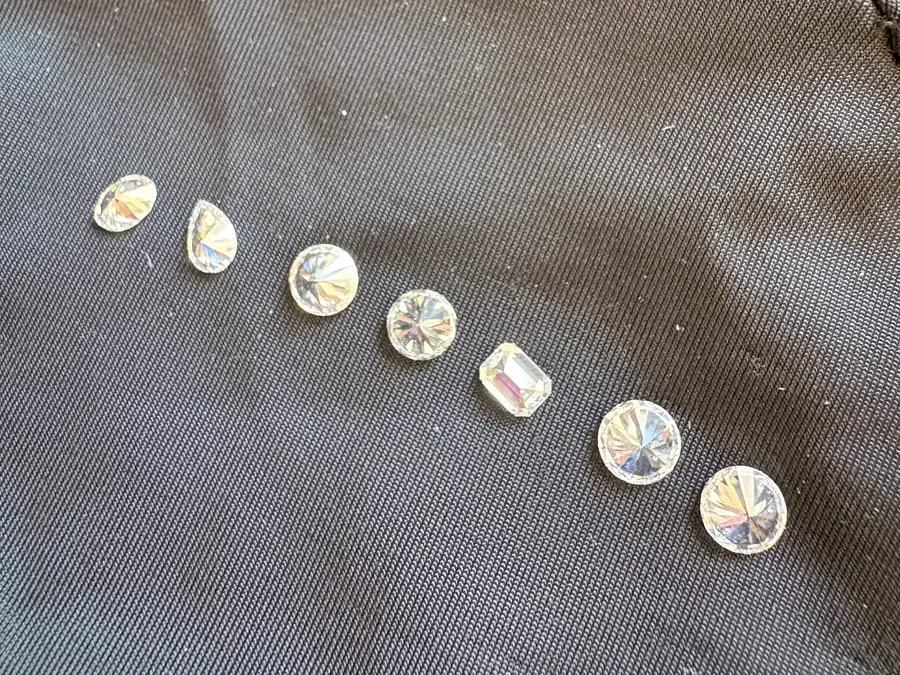
In ordinary light
Light in, light out
Fluorescence belongs to a family of effects called luminescence: a material absorbs energy and gives some of it back as visible light.
Inside the crystal, an electron sits at a settled energy. When ultraviolet light arrives, the electron can absorb that energy and jump to a higher, unstable level. It cannot stay there. As it drops back, the energy it borrowed has to go somewhere — and part of it leaves as light we can see.
Fluorescence and phosphorescence
Two versions of this are useful to a gemmologist, and the difference between them is timing.
Fluorescence happens while the ultraviolet source is on. Switch it off and the glow ends with it.
Phosphorescence continues after the source is removed. The stone keeps emitting for a moment on its own. Usually this lasts a fraction of a second and no one notices; the eye only registers it when it persists for a second or more. A diamond can fluoresce one colour and phosphoresce another.
The light coming out is always weaker than the light going in
Some energy is lost as heat along the way, so what is emitted always carries less energy than what was absorbed. This is why ultraviolet — too energetic for our eyes to register — can produce a blue or green glow that we see easily. The stone shifts the light down into our range.
A perfect crystal does not glow
A diamond of pure carbon, with every atom in its place, has nothing to absorb the energy and nothing to give back. It stays dark.
What makes a diamond glow is imperfection. Here and there a foreign atom takes the place of a carbon one — nitrogen most often, boron far more rarely — or an atom is simply missing, leaving an empty position in the lattice. These irregularities are what catch the ultraviolet energy and release it again as light we can see.
Which colour comes out depends on which irregularity is present, and on how those atoms happen to be arranged around it.
Which defect, which colour
Several defects are common enough to be worth naming. A vacancy simply means a place in the lattice where an atom is missing.
| Defect | Structure | Fluoresces |
|---|---|---|
| N3 | Three nitrogen atoms around a vacancy | Blue |
| H3 | Two nitrogen atoms around a vacancy | Green |
| NV | One nitrogen atom beside a vacancy | Red |
| 480 nm band | Structure still uncertain | Yellow |
Blue is by far the most common in colourless diamonds, and it comes from N3. When a report says Strong Blue, that is almost certainly what it is describing.
The same defects can also affect the stone’s ordinary colour. H3 is a good example: it can add a green cast to the body colour in daylight, because daylight carries enough ultraviolet to set it going.
Not all ultraviolet is the same
Gemmologists use two wavelengths, longwave and shortwave, and a stone can respond quite differently to each. A parcel that looks uniformly blue under one lamp can separate into several reactions under the other.
That is a practical tool rather than a curiosity. Luminescence reveals differences in crystals that look identical under ordinary light, which makes it useful for sorting a parcel quickly and finding the stones that need closer examination.
What the report is actually telling you
Fluorescence is not one of the 4Cs. GIA records it as an identifying characteristic — a way of telling one stone from another, like a fingerprint — rather than a measure of quality. The colour is noted when the intensity is Medium or above.
Two consequences follow. A grade of Very Strong describes how brightly a stone reacts to a laboratory lamp; it does not describe how the diamond looks on a hand in a restaurant. And because fluorescence is an identifying feature, it is one of the details that ties a particular stone to a particular report.
Does it change how the diamond looks?
Mostly, no. When GIA tested this with ordinary observers in the kind of lighting where jewellery is actually bought and worn, no consistent fluorescence-related effect could be picked out. Some strongly blue fluorescent stones were judged to look better face-up than their colour grade implied.
There is a straightforward reason. Blue and yellow are opposites; on a warmer diamond, roughly I to N, a blue glow can cancel part of the yellow and make the stone read whiter than its grade.
Fluorescence has no effect on durability — the structures responsible are far too small to weaken anything — and none on sparkle, which comes from cut.
Where the trade genuinely disagrees is price. Some hold that a very high colour stone with extremely strong blue fluorescence can look slightly hazy, and discount it accordingly. Others pay more for fluorescence in a lower colour, for exactly the reason above. Both views exist in the same market, which is worth knowing when a price looks unusually good.
In one sentence
Fluorescence is a diamond turning invisible light into visible light, using flaws in its own structure to do it — a description of the crystal, not a verdict on the stone.
If you are looking at a certificate that says Strong Blue and wondering what it means for that particular diamond, send it to me and I will read it with you.